These instructions must be strictly adhered to for warranty validation.
Fitting Centre-lock Wire Wheels
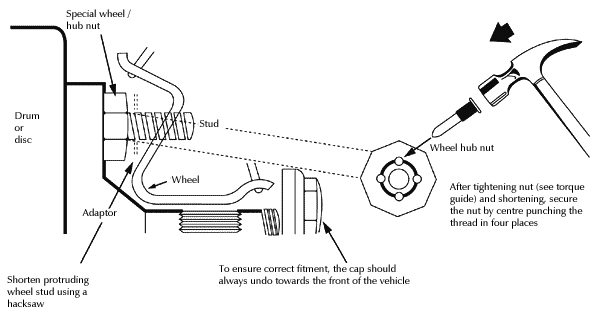
A centre-lock wire wheel is fitted onto a car axle using a splined hub; the splines (or serrations) of the hub lock with the splines on the inside of the wheel centre to produce drive. Splined hubs may be integral fitting or bolt-on. Please refer to the vehicle’s service manual for instructions on fitting integral splines. The diagram below illustrates fitting bolt-on hubs.
When putting a centre-lock wheel onto a splined hub, the splined area inside of the wheel centre must be greased to ease the wheel on and prevent the two surfaces corroding together. All new MWS centre-lock wheels are provided pre-greased; ready to go on the car.
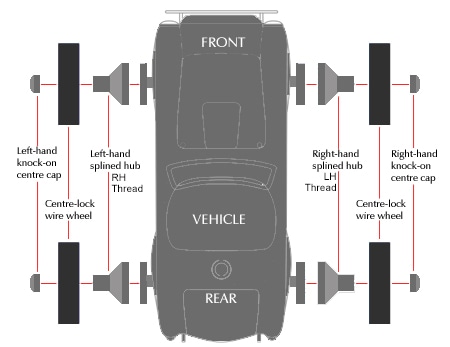
The wheel is secured onto the hub with a spinner (knock-on centre cap). The spinner should always tighten towards the rear of the vehicle; this ensures that as the wheel turns whilst driving the spinner tightens and locks into place.
A spinner spanner is required to apply/remove spinners without ears, such as octagonal (Continental/Federal). The spanner fits over the spinner and is tightened/loosened with a hammer. ACWW can supply the following spinner spanners:
Spinners (or knock-on caps)
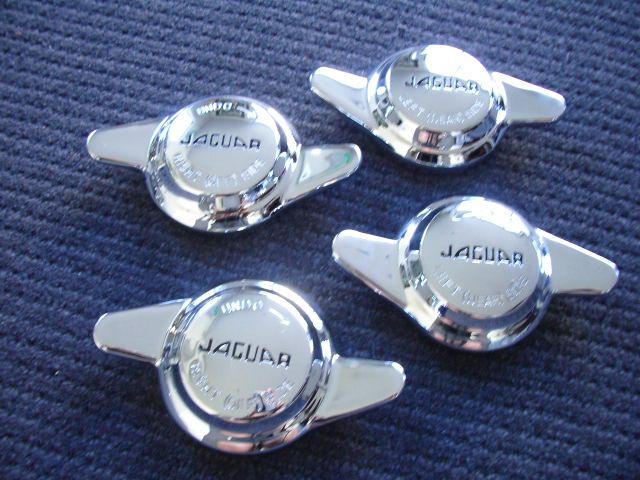
Two-eared and three-eared spinners can be tightened/removed by using a copper and hide hammer or lead hammer directly onto the ears of the spinner. ACWW recommends using a wooden spinner saver for two-eared spinners. There are no recommended torque settings for spinners and the exact number of turns will vary from one vehicle to the next.
A spinner should be fitted with the wheel jacked up off the ground so that the hub, wheel and spinner are all centralised.
Apply the spinner by hand and tighten 3 to 3½ turns; give the spinner a couple of taps with the hammer; lower the wheel to the ground and give the spinner a couple more taps with the hammer.
As long as the hubs are fitted correctly then the spinners will self-tighten and lock as the car is driving.
If you hammer the spinners too enthusiastically then you will deform the thread of the spinner and the hub and they are more likely to work loose.
Over-tightening also means that if you ever need to replace either the hub or spinner then you will also need to replace the other part as the deformed thread of the old part will not fit with the new thread.
If your spinners keep coming loose then it is probably because the hubs have been fitted on the wrong side. For example, the left hub goes on the left-hand side of the car as you sit in it, not on the left as you look at it from the front.
Fitting Bolt-on Wire Wheels
Bolt on wire wheels are fitted to a car in the same way that a standard wheel would be fitted to a car. The wheel options are determined by the P.C.D. (Pitch Circle Diameter) as well as the centre bore, size and back spacing of the wheel.
All ACWW bolt-on wire wheels are supplied with a centre cap, retaining nuts and a wrench to tighten the bolts. Replacement accessories are available from stock. For bolt-on wheels the recommended torque is as per vehicle manufacturer specifications.